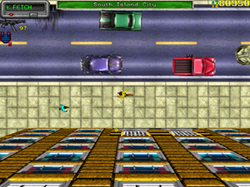
AmiGTA1 has progressed from a city-driving experiment to a native Amiga version of Grand Theft Auto with missions, police and sound. Developer Grzegorz Korycki’s latest published build, v0.6.1, dates from 26th September 2026.
The project rebuilds the 1997 game’s engine for AmigaOS 68k. It targets a 68020 or better with AGA or RTG graphics, rather than running the PC executable through an emulator.
September’s release notes describe a fuller city soundscape, including voices, engines, horns, sirens, skids and crashes. They also list a fix to prevent music channels from swallowing sound effects.
Version 0.5.0 introduced effects through the Amiga’s Paula hardware and a car radio using converted soundtrack files. The release archive’s documentation lists Paula as the working sound route, with AHI still unfinished.
Another change makes vehicles solid when the player is on foot, addressing the ability to walk through or underneath them. Police also receive their own uniform, and their pursuit state resets after a hospital visit.
Liberty City on Amiga hardware
The port’s mission work follows the original level script. The developer documents the first two Liberty City jobs running from their opening telephone call through to payment, alongside the original pager and mission displays. This remains a work in progress rather than a completed conversion of every city and mission.
A traffic limit offers a practical adjustment for different machines. The setting ranges from six to 50 moving vehicles, with 18 as the default. Parked cars and wrecks sit outside this limit. The developer identifies traffic simulation as a major CPU cost on slower Amigas.
The supplied hardware requirements specify around 8MB of Fast RAM and no FPU. Performance depends on the machine and display settings, with higher-resolution modes adding further rendering work.
AmiGTA1 includes an engine and conversion utilities, but no GTA game data. Players need their own PC copy, with the port built around the DOS release’s 8-bit data. The documentation also identifies the corresponding files in the 2002 Windows rerelease.
Both LHA and ZIP packages are available from the v0.6.1 release page. The project repository provides the source code and documentation.