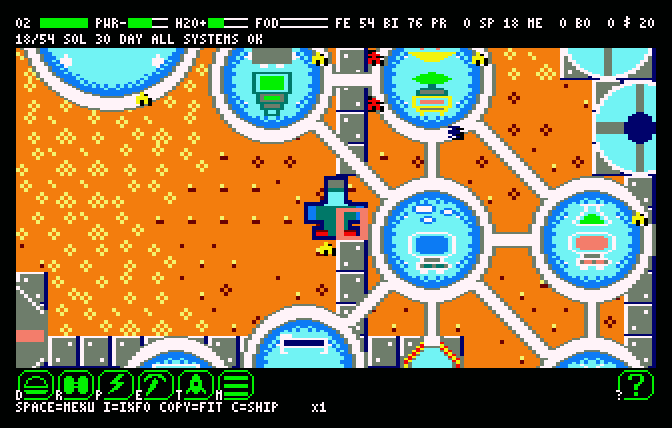
Revive8Bit released Habitat for the Amstrad CPC 6128 on 7th November 2026. The colony strategy game drops six settlers on a world with ice below the surface and too little air to breathe. Their ship carries metal and bioplastic, but there’s no base waiting for them.
You decide what to build. The settlers take the jobs those buildings create without waiting for orders and see to their own meals and rest. Revive8Bit describes an engineer repairing equipment and a biologist growing food under glass.
Revive8Bit’s account of the landing starts with a dome and an airlock. A pump draws water from ice, an oxygen generator supplies breathable air and solar panels provide electricity by day. After dark, the settlement relies on stored power. When a sandstorm hits, the crew takes shelter.
As the base grows, corridors connect the domes. Quarters give the crew somewhere to sleep, a canteen cooks meals and a medbay treats the sick. The building menu also lists wind turbines alongside the solar panels. There’s a mine for ore and a factory for metal and parts. Extra storage buildings give the colony room for more goods.
A separate resource screen distinguishes what the settlement produces from what it uses. In one of Revive8Bit’s screenshots, an 18-person colony produces more oxygen than it consumes but uses slightly more power than it generates. The same screen shows how much electricity the base has in reserve.
Trade and migration change what the landing site is for. Revive8Bit describes merchants coming to trade, newcomers swelling the population and visitors paying to see the settlement. A hostile landing gives the guards work of their own.
Even the original ship finds a use once the settlers have a place to stay. In the developer’s account, the crew dismantles it plate by plate and adds the material to the colony’s stockpile.
From city planning to colony survival
The CPC had a different kind of settlement builder in 1990, when Probe Software converted SimCity for the machine. Players laid roads, zoned land and built a power grid. An unpowered zone would fail to develop. In Habitat, power is part of the life support for a crew small enough to fit in one ship.
Habitat follows Revive8Bit’s own Mars Terraforming, released for the CPC in September 2026. The earlier game gives players a planet to reshape, with targets for temperature, pressure, atmospheric oxygen and water coverage. Habitat keeps the scale closer to the landing site, from the first dome to a settlement with people and ships coming and going.
The game supports saving to disk. The Habitat release page offers a 199 KB disk image as a name-your-price download, alongside separate manuals in English and Greek.
