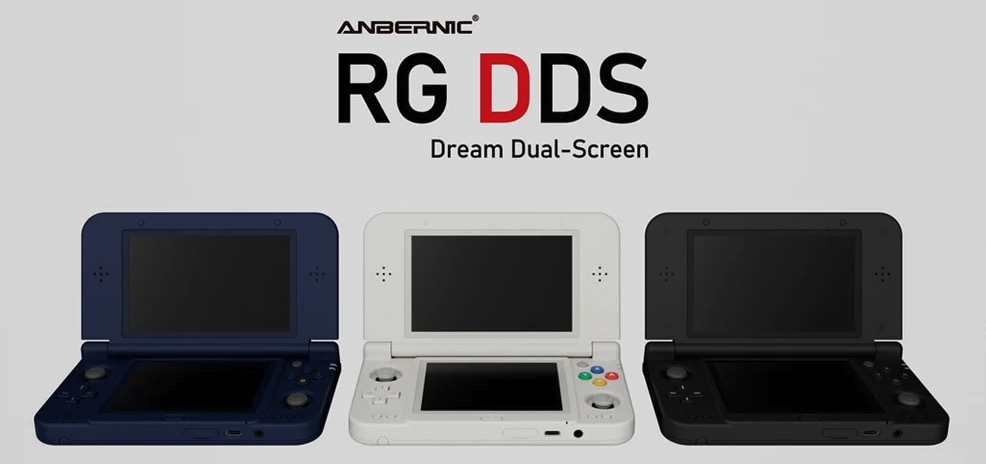
Anbernic has announced the RG DDS, a folding dual-screen handheld with a design closely resembling Nintendo’s New 3DS. Its name stands for Dream Dual-Screen, and the company positions it as its new flagship.
The reveal pairs familiar Nintendo-style controls and colours with a Qualcomm Snapdragon G2 Gen 2 chipset. Glasses-free stereoscopic 3D does not feature in the announcement, despite the resemblance to Nintendo’s hardware.
Anbernic has shown blue, white and black versions. The white model uses coloured face buttons reminiscent of the white New Nintendo 3DS, while the speaker grilles and overall shape follow a similarly familiar layout.
There are two analogue sticks, with the right stick sitting below the face buttons. A D-pad and ABXY buttons flank the lower display, while a retractable stylus stores inside the handheld when you finish using it.
Anbernic also includes a dedicated AI button above the X button. Its initial announcement does not explain the button’s functions. Meanwhile, front-facing stereo speakers and a Z-axis linear vibration motor supply the audio and vibration features.
The two displays use different proportions, following the 3DS arrangement of a wider upper screen and a more square lower screen. Anbernic has chosen custom IPS panels for both, rather than giving each half an identical display.
Two screens sized around the 3DS layout
The upper screen measures approximately 4.7 inches, with a 1200 × 720 resolution and 5:3 aspect ratio. Below it, the approximately 4-inch panel offers 960 × 720 pixels at 4:3.
According to Anbernic, each panel triples the horizontal and vertical pixel dimensions of the corresponding original 3DS image. This provides a three-times integer scaling option while preserving the original proportions. At this scale, each source pixel occupies a three-by-three block of display pixels, producing nine pixels for every original one.
The manufacturer lists 300 pixels per inch and 500-nit brightness for both screens. It also says it has matched their colour, brightness, refresh rate and materials to give the upper and lower displays a consistent appearance.
Inside, an active cooling system uses an internal fan, alongside the Snapdragon processor and a 6,000 mAh battery. The battery specification describes its capacity, without supplying a confirmed number of hours between charges.
The software includes a redesigned control centre with performance, cooling, brightness, volume and dual-screen settings in one panel. Device status appears alongside those controls. Meanwhile, dual alloy friction hinges support the lid, and the shell has a UV-coated finish.
Anbernic has not announced a price or release date in this reveal. You’ll find the manufacturer’s presentation and hardware details in the official RG DDS announcement.