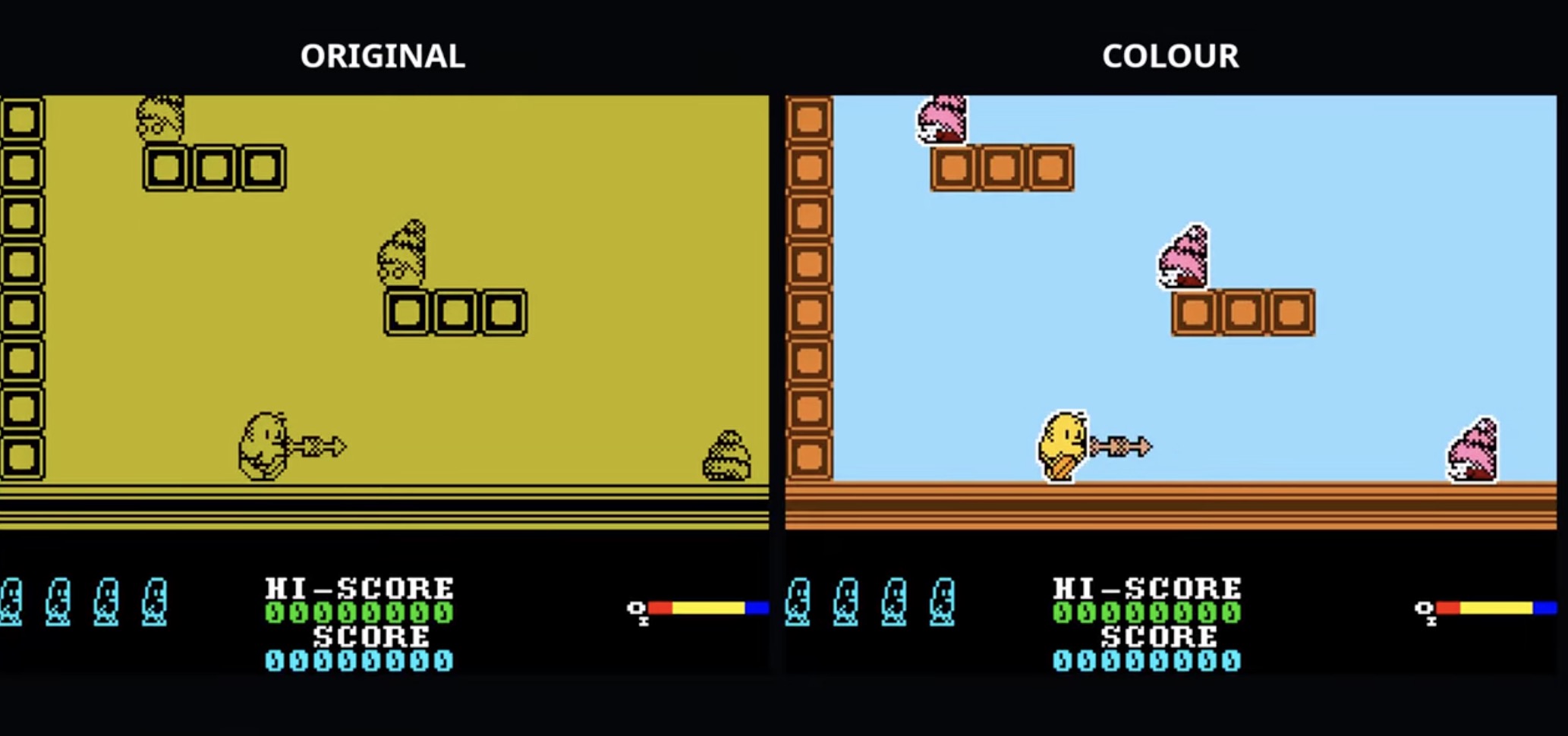
Jon Attree has released a collection of .nxc patches for the ZX Spectrum Next, offering colour-clash fixes and optional enhancements for owners of the original games. His announcement lists 33 games available, with about 90 on the wider project list.
The format builds on NexClash, created by Dean Woodyatt. NexClash replaces a Spectrum game’s moving figures with Next hardware sprites, allowing those figures to retain their own colours as they cross the scenery.
On the original Spectrum, an 8×8-pixel character cell shares its ink and paper colours. A moving character and the background therefore compete for the same colour attributes. NexClash uses the Next’s additional graphics hardware to change how those figures appear.
The .nxc format addresses distribution. A complete converted build contains the original game, while a patch requires a matching game file supplied by the player. The loader checks the file before applying the changes. A reconstructed .nex includes the game and is intended for the owner’s own use.
Jon’s documentation adds an important qualification: patches contain no copy of the original game’s code or levels, but sprite builds include graphics derived from the game, stored encrypted. Contributors also need agreement from the creator of the build before sharing it.
Available options vary between games. The menu offers the original appearance or colour-clash fixes, alongside supported cheats and alternative colour sets. Jon names Nightshade, Nodes of Yesod and Pyjamarama among the games with hand-painted Enhanced colours.
His video uses New Zealand Story to demonstrate changes beyond colour clash. Jon reports smoother scrolling and removal of slowdown. He also describes timing checks against the originals, with a target within 2% and no faster than the original pace. These are developer-reported results.
Dean has integrated .nxc output into NexClash, giving contributors a route to package and share their work without distributing complete converted games. The process uses the existing Next platform rather than requiring a custom FPGA core.
The project remains early. Its README reports emulator testing and a loader run on Jon’s NextNano with NextZXOS 2.09. It explicitly says the loader has not yet run on an official Spectrum Next board. Testing coverage varies by game, with individual patches recording their own evidence.
The .nxc repository contains the patches, documentation and loader. Dean’s NexClash repository documents conversion and patch creation. Jon explains the project in his NextTang video.