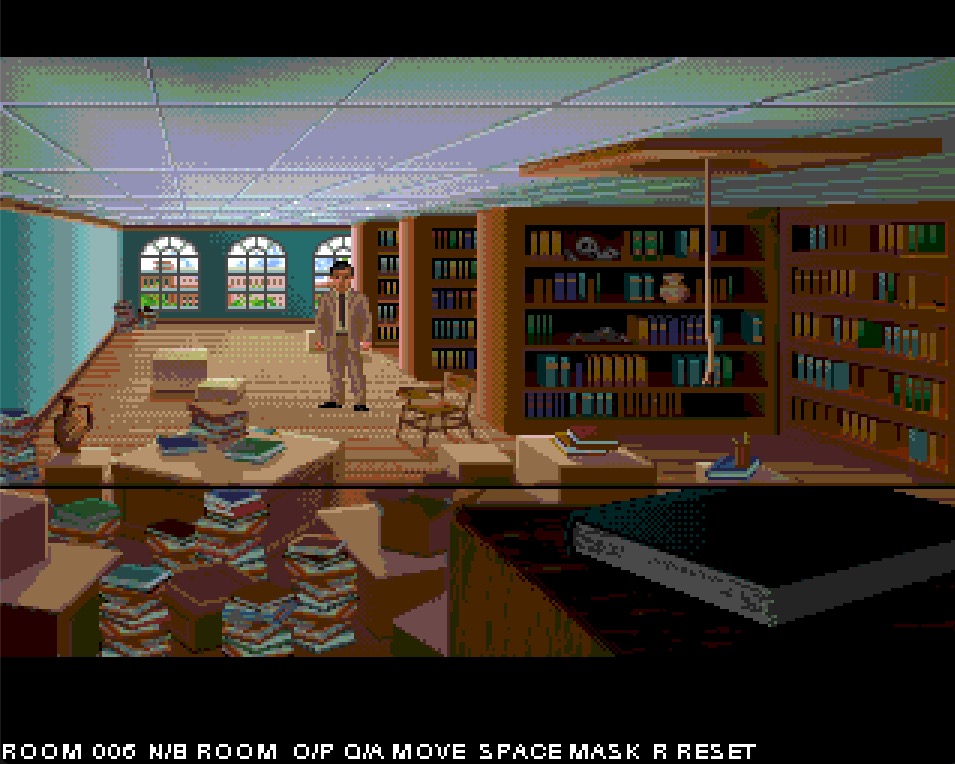
Indiana Jones is moving through Fate of Atlantis scenes on the ZX Spectrum Next in an early experiment from Croft Soft Software. The studio’s development update, published on 19th October 2026, describes progress on scene loading, keyboard movement and the masking which lets Indy pass behind objects.
The work remains an exploratory side project. Croft Soft has put it on hold while prioritising its own games, with further development expected to take place around those commitments over the coming months.
According to the update, the project loads every screen from the original adventure, including its objects, masks and walkboxes. Indy already moves around scenes through keyboard input, although the developer describes his movement as slow.
Mouse input and routefinding remain planned. Sprite scaling is next on the development list, followed by mouse control, before an attempt to reproduce the adventure’s scripted opening sequence as closely as possible to the 16-bit releases.
The working masks are one of the reported milestones. They allow the character to move behind elements within a scene, preserving the relationship between Indy and the environment rather than leaving him drawn over everything.
From Maniac Mansion to Atlantis
Croft Soft began with a fork of an existing ScummVM project for the Spectrum Next, built around the NES version of Maniac Mansion. The Atlantis experiment therefore develops an earlier attempt to bring LucasArts adventure technology to the machine.
ScummVM provides a way to run supported adventure games using their existing data files. It replaces the games’ original executable programs with new implementations, rather than emulating the computers they originally ran on. Players still need to supply the original game data.
The Atlantis experiment works with scene information from the original adventure, including its object and masking data. Its present milestones concern displaying those scenes and moving Indy within them, before the planned work on scripted sequences.
The project grew out of the developer revisiting Fate of Atlantis through ScummVM on an Atari Falcon. Playing the adventure again prompted the question of how much of it the Spectrum Next might handle.
Croft Soft has not attached a release date to the experiment. Its development journal documents the current state and the intention to return to it after work on the studio’s original games.
Disclosure: Croft Soft Software is a sister entity of SpriteFountain.