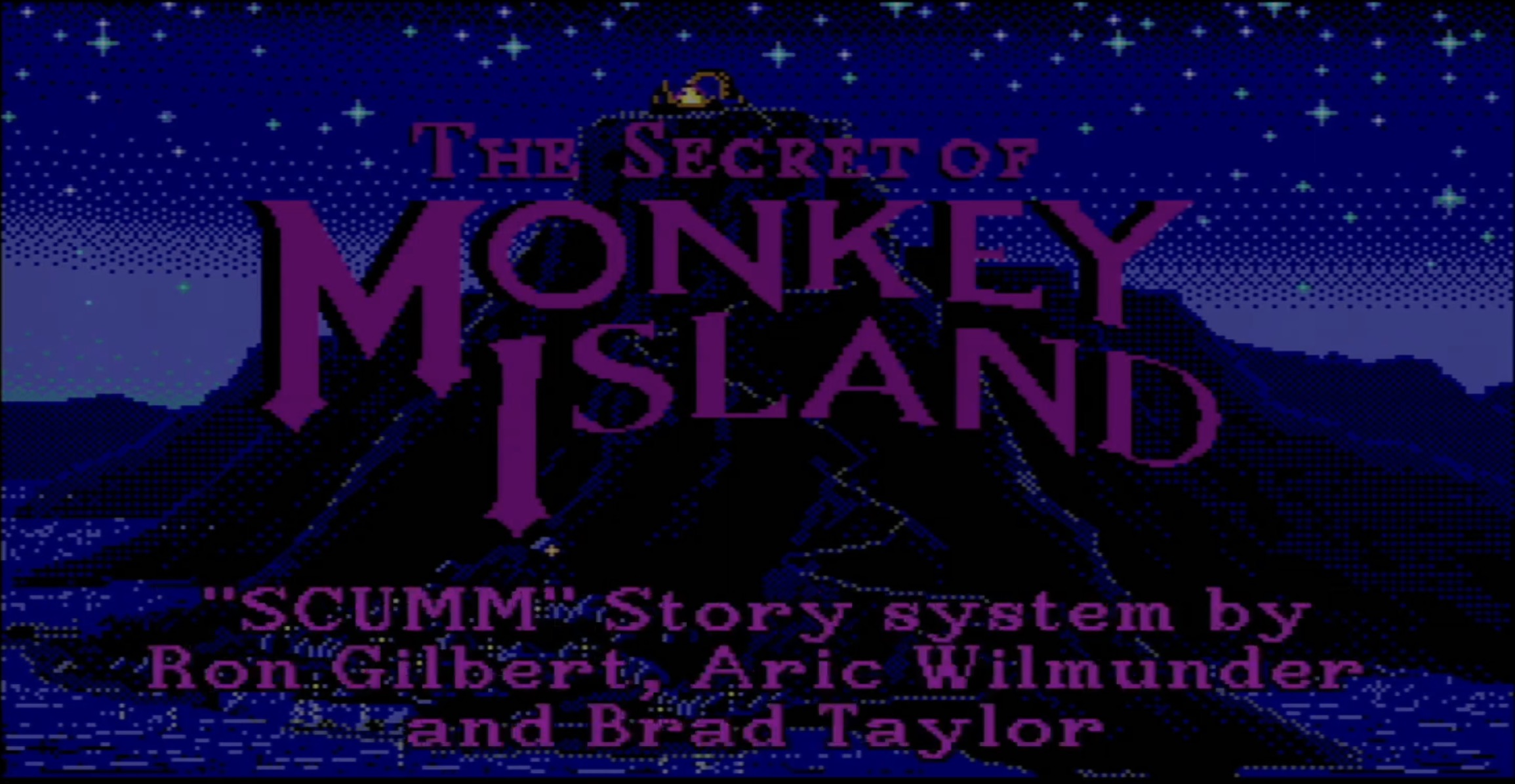
The Secret of Monkey Island begins with a young man standing on a moonlit cliff, looking out over Mêlée Island, and deciding that he wants to be a pirate. That is all the invitation the game needs. No prophecy. No destiny. No brooding hero shot. Just Guybrush Threepwood, a name that already sounds like a joke someone was pleased with, stepping into a world that is ready to test how long his confidence can last.
First released by Lucasfilm Games in 1990, The Secret of Monkey Island belongs to the golden age of point-and-click adventures, but it has never felt trapped inside that phrase. It is an old game, unmistakably so, with its verb bar, measured pacing and screen-by-screen geography. Yet the writing has bite, looseness and timing that many modern comedy games would envy.
I first played it on the Atari ST, and that memory matters. The game was not a glossy object then. It was a thing of disks, loading, reading, trying, failing, saving, wandering and laughing at a line you had not expected. The ST version did not need lavish presentation to make Mêlée Island feel like somewhere worth exploring. It had enough: sharp scenes, expressive dialogue and a cast of oddballs who seemed to know the joke before Guybrush did.
The original game appeared across several formats, including DOS, Amiga, Atari ST and Macintosh, with later versions for FM Towns and Sega CD. Those versions do not create a single memory. They create a cluster of memories: the PC player remembering the early EGA look or later VGA richness, the Amiga player remembering the warmth of the machine’s sound, the ST player remembering clarity, timing and text. Underneath those differences sat the same sharp comic machinery.
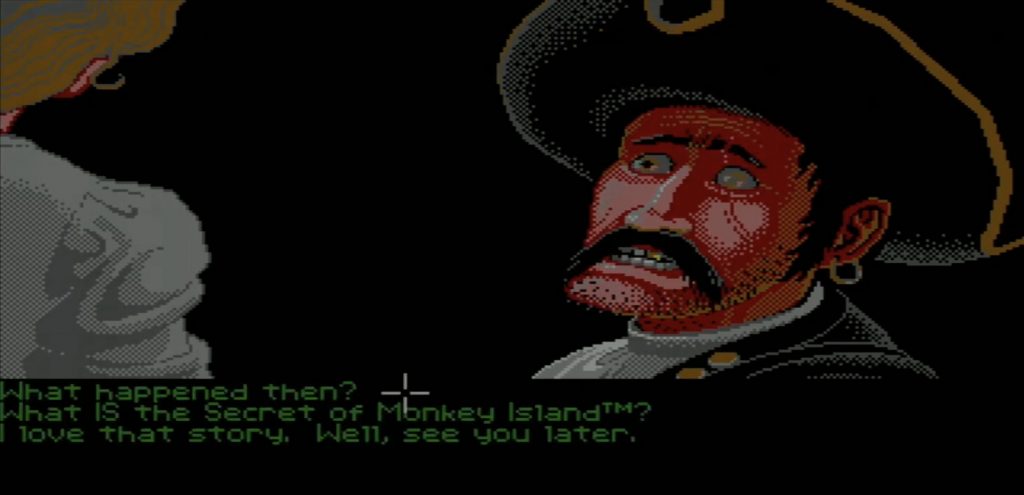
That machinery is language. Monkey Island looks like a pirate adventure, but it behaves more like a comic conversation that keeps changing shape. The player is not rewarded for aggression. Guybrush succeeds by listening, repeating, misunderstanding, bluffing and occasionally finding the one ridiculous object that makes a ridiculous situation make sense.
It is easy to talk about Monkey Island as if its importance is mainly historical. That sells it short. The game helped define what a friendlier adventure game could be, especially in contrast with harsher designs where a wrong move could kill the player or quietly ruin progress. But the reason people return to it is simpler. It is funny in a way that comes from character, structure and rhythm, not from jokes pasted over puzzles.
Mêlée Island makes piracy feel like a local trade
Mêlée Island is one of the great opening spaces in adventure games because it feels both small and full. There is the lookout above the town, the Scumm Bar with its permanently unimpressed pirates, the church, the shop, the jail, the governor’s mansion, the circus and the forest paths that seem designed to make newcomers feel faintly foolish. It is a stage set, but a good stage set. Every room knows what kind of scene it wants to host.
The Scumm Bar is the perfect early statement of intent. In another pirate story, this might be where the hero proves himself with violence. Here, the pirate leaders sit around like bored gatekeepers at a failing club. They are grubby, absurd and oddly procedural. Guybrush wants romance and danger. Mêlée Island gives him bureaucracy with beer stains.
That is where the game’s view of piracy becomes so sharp. To Guybrush, being a pirate is a dream. To everyone else, it is a trade with rules, habits, petty rivalries and local knowledge. The joke is not only that Guybrush is unprepared. It is that he has walked into a community that already has its own language, and he has to learn it one humiliation at a time.
The three trials give the opening act a clear shape without making it feel rigid. Treasure hunting, thievery and sword fighting sound like traditional pirate business, but each task bends away from action and towards comic problem-solving. Monkey Island understands that making the player feel clever is better than making Guybrush look impressive.
That is why the Sword Master thread remains one of the finest adventure-game ideas of its period. The game takes a combat expectation and turns it into a verbal memory test. Guybrush learns insults from wandering pirates, then learns which replies cut them down. The blade is almost decorative. The real weapon is the comeback.
The pleasure of the sequence comes from the way it teaches without sounding like instruction. At first, Guybrush is hopeless. Then a few replies start to stick. Then the player begins to recognise the shape of the exchange before the right answer appears. By the time Guybrush reaches Carla, the Sword Master of Mêlée Island, the whole routine feels earned.
Carla works because she is not there to flatter the player. She is sharper than Guybrush, more assured than Guybrush and completely unmoved by his desire to become a pirate. Beating her does not feel like overpowering her. It feels like Guybrush has finally learned enough of the island’s language to avoid embarrassing himself for five minutes.
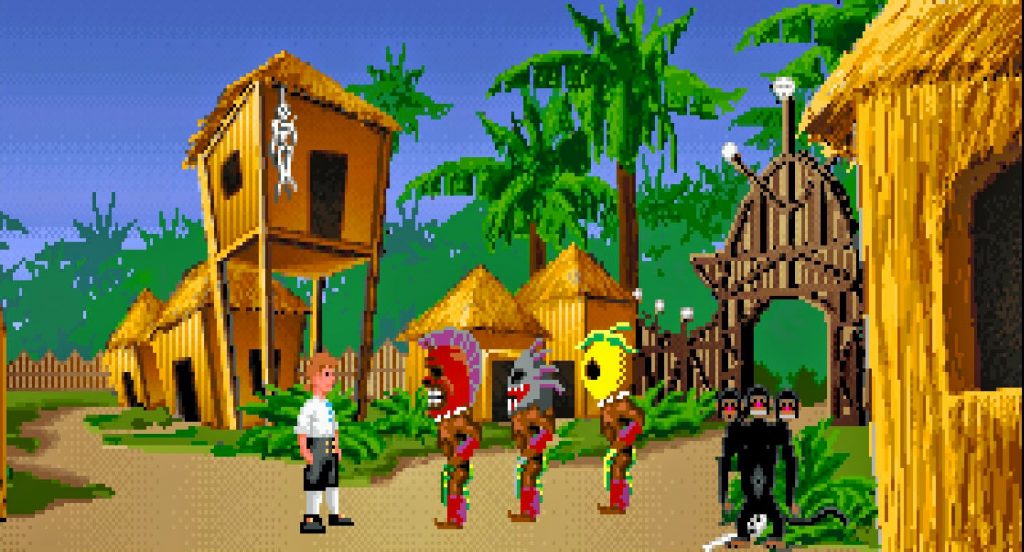
The three-headed monkey joke belongs to the same comic system. It is childish, but knowingly so. Guybrush uses it as a distraction because it sounds exactly like the kind of nonsense a desperate person would say. The game then keeps playing with it until it becomes part of the shared vocabulary between player and story.
What makes these jokes endure is not only the wording. It is placement. The game knows when to undercut a dramatic beat, when to let a character talk too long, when to make Guybrush sound proud of something foolish and when to leave a pause for the player to catch up. The dialogue sparkles because it is doing work. It builds the world while making fun of it.
Elaine Marley is central to that balance. She is introduced through Guybrush’s wide-eyed fascination, but the game does not reduce her to his fantasy. Elaine is capable, politically aware and far more in control of the island than he is. Their dynamic works because Guybrush’s sincerity is allowed to be charming, while his self-image is constantly punctured.
LeChuck gives the story its larger shape without dragging it away from comedy. A ghost pirate is a strong villain idea, and the game gives him enough presence to make the threat readable. At the same time, he belongs to a world where grog is practically industrial acid and a rubber chicken with a pulley in the middle can solve a transport problem. Monkey Island never forgets what kind of story it is telling.
The original version understands the pace of a joke
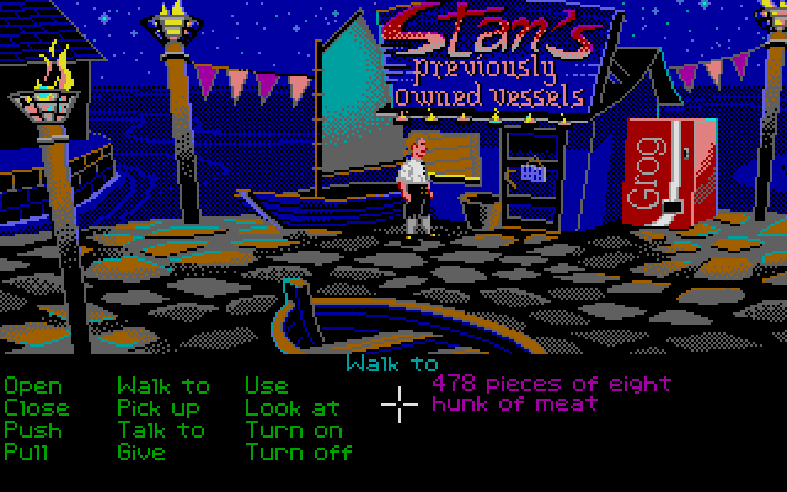
The original version matters because its interface, pacing and limitations are part of the comic experience. The verb bar can feel slow beside modern adventure games, but that slowness is not always a weakness. Choosing the wrong command often produces a line worth reading, and the act of trying verbs becomes part of the game’s timing.
The strongest moments are the ones built from language and behaviour: insult sword fighting, the Sword Master, the three-headed monkey, the grog errands, the Scumm Bar conversations and Guybrush’s habit of sounding certain while knowing almost nothing. Some puzzle chains ask for an older kind of patience, and a few routes can feel loose by current standards, but the trade-off is personality. The original gives its scenes room to breathe, and the jokes benefit from that space.
The visual style of the original leaves room for imagination. Mêlée Island at night has enough colour and shape to feel mysterious without turning gloomy. Interiors are arranged so the player can read them quickly, but they still have character. The game does not swamp the screen with detail. It gives the dialogue room to lead.
On Atari ST, that economy suited the machine. The crispness of the screens and the emphasis on text made the world feel theatrical, like a set of comic panels waiting to be activated. The limitations were obvious, but they were not fatal. Monkey Island did not depend on spectacle. It depended on whether a room, a line or a puzzle could make you want to try one more thing.
The Amiga, DOS, Macintosh, FM Towns and Sega CD versions each gave the game a different surface, especially through colour and sound. That variety is part of the game’s history. Players did not all meet the same Monkey Island in exactly the same form, yet the design underneath was strong enough to carry across hardware. Guybrush, Mêlée Island and the insult fights survived every format shift.
The music also plays a quiet role in how people remember it. Depending on platform, the audio could be fuller or more modest, but the theme’s Caribbean bounce gave the adventure an identity before the plot had done much at all. It sounded playful rather than grand, which was exactly right. Monkey Island was never trying to be the biggest pirate story. It was trying to be the most quotable one.
The famous rubber chicken with a pulley in the middle is absurd, but it is absurd in a world that has prepared you for exactly that kind of solution. Grog behaves like a dangerous substance. Pirates care about insult technique. Important people are strangely casual. Once the game has taught you its rules, its weird answers begin to feel fair.
The decision to make failure funny rather than punishing gives the whole adventure a generous mood. Guybrush can look foolish without the player feeling attacked. Dead ends are softened by jokes, and experimentation is usually rewarded with at least a reaction. That design choice matters. It makes the player more willing to poke at the world, which in turn makes the world feel more responsive.
Guybrush is one of the best adventure-game leads because he is built for that process. He is not a blank slate, but he is not so fixed that the player feels locked out of him. His ambition is clear, his ignorance is useful and his ego is soft enough to dent repeatedly. Every time he fails, the game becomes more itself.
Elaine and LeChuck also benefit from that structure. Elaine gives the story a person who sees through Guybrush without dismissing him entirely. LeChuck gives it a theatrical threat that can survive being mocked. Between them, Guybrush is pulled between romance, danger and farce, which is exactly where he belongs.
That quality is part of why the original version should not be treated as a rough sketch for later editions. The Special Edition made the game accessible to newer players, but the 1990 release has its own rhythm. The verb bar, the text-heavy exchanges, the limited animation and the compact staging all shape how the comedy works. Remove too much friction and you risk changing the pace of the joke.
For players returning after decades, the game can feel both smaller and sharper than memory suggests. Some screens are sparse. Some puzzle steps require a mindset that modern games have trained out of us. Yet the best scenes are not only nostalgia. They work because the writing, puzzle logic and character detail are pulling in the same direction.
For new players, the first adjustment is pace. The Secret of Monkey Island asks you to read closely, listen to repeated dialogue, examine objects and accept that the funniest route is often indirect. Once that rhythm clicks, the game opens up. It becomes less about solving a pirate quest and more about learning how this odd community thinks.
That may be the real secret in the title. Monkey Island is not only a place to reach. It is a way of thinking: sideways, verbal, mischievous and oddly polite beneath the sarcasm. The game invites the player to stop acting like a conventional hero and start acting like Guybrush, which means trying the foolish option because the foolish option might be exactly right.
More than thirty years on, The Secret of Monkey Island remains worth revisiting because it has not been reduced to its reputation. The Sword Master sequence is more than a famous bit. The three-headed monkey is more than a meme before memes. The dialogue is more than a collection of quotable lines. All of it belongs to a design that understands comedy as interaction.
That is why the original still matters. Not because every pixel has aged perfectly, and not because every puzzle is beyond criticism. It matters because it captures a rare tone: silly without being stupid, clever without being smug, affectionate without becoming soft. Guybrush Threepwood wanted to be a pirate. The game’s joke, and its charm, is that he became something better: a hero who could win a fight with words.