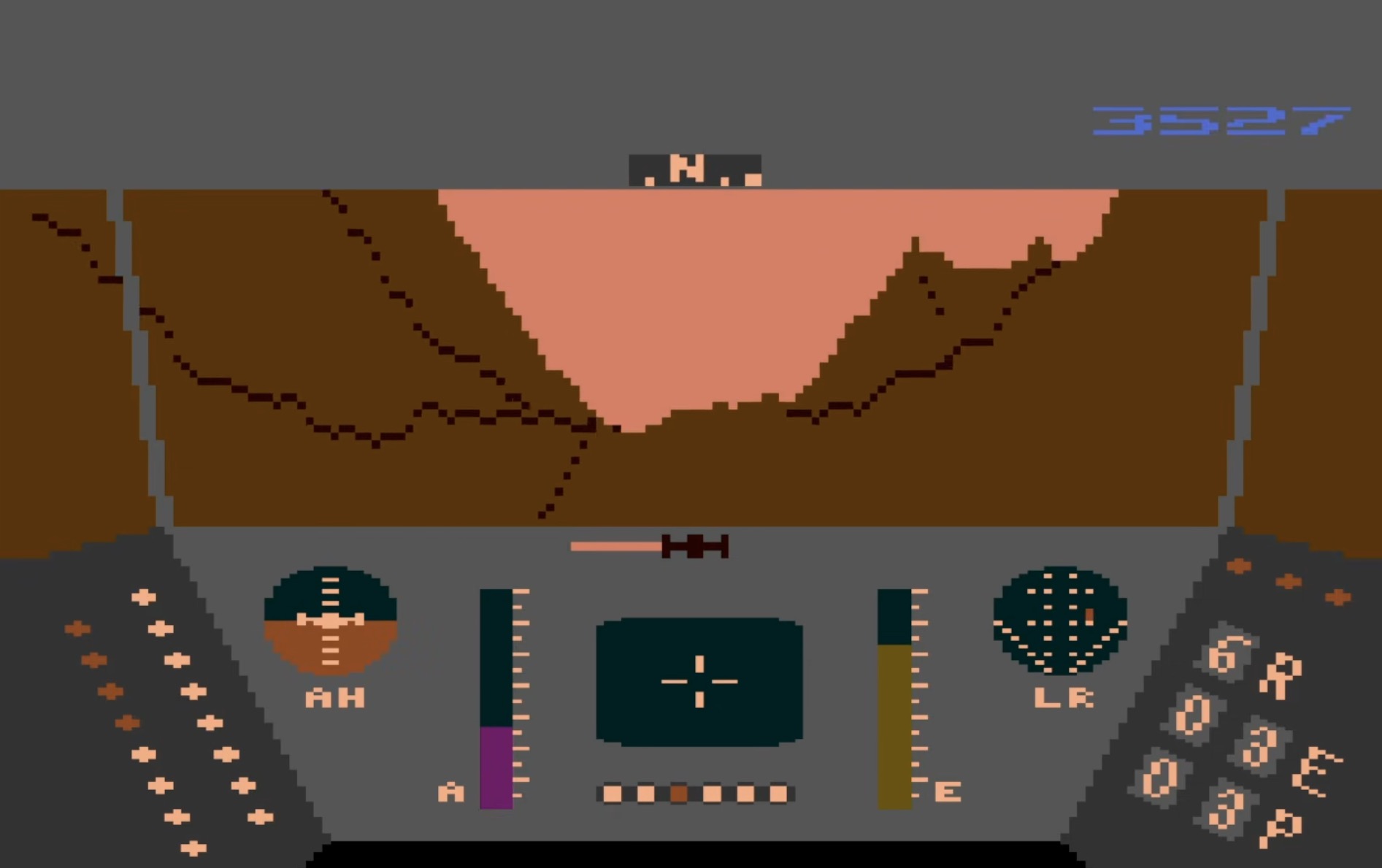
Rescue on Fractalus! has finally reached the Amiga, more than 40 years after Lucasfilm Games first sent players skimming across the mountains of Fractalus on 8-bit hardware.
The new port comes from Vesuri and has now reached version 1.0, moving beyond the earlier beta builds into a finished release. It requires an Amiga with 1MB of RAM, so an unexpanded 512KB Amiga 500 is not enough, and development and testing took place on an A500+ running Kickstart 3.1.
Kickstart 1.3 PAL systems are also supported, giving the port a route onto hardware much closer to the Amiga machines that would have been sitting in homes during the computer’s original commercial life.
It is a particularly interesting gap to fill because Rescue on Fractalus! predates the Amiga itself. Lucasfilm Games released the original in 1985, initially for Atari 8-bit computers before versions appeared across machines including the Atari 5200, Commodore 64, Apple II, ZX Spectrum, Amstrad CPC and Color Computer 3.
One of Lucasfilm Games’ earliest worlds comes to Amiga
Rescue on Fractalus! was one of the first two games developed by the newly formed Lucasfilm Computer Division Games Group alongside Ballblazer. Peter Langston led the group, with David Fox serving as project leader and designer on Rescue on Fractalus!, while Loren Carpenter, Charlie Kellner and Gary Winnick were among the other names involved in its creation.
The game began life with Atari hardware firmly in mind. Lucasfilm’s Games Group had been established in 1982 with funding from Atari, giving the company first refusal on publishing the team’s games before changes at Atari disrupted those original plans.
At its core is a first-person search-and-rescue mission. The player flies a Valkyrie fighter low across the surface of Fractalus, using a direction finder to locate stranded Ethercorps pilots among mountain ranges generated using fractal techniques.
Those mountains were a substantial part of the game’s identity. Instead of presenting a simple flat horizon, the terrain rises into jagged ridges that can obscure pilots and force the player to pay attention to altitude while navigating through the planet’s hostile atmosphere.
The rescue procedure is more involved than simply touching down beside a marker. Once close enough to a stranded pilot, the player shuts down the Valkyrie’s engines and shields, waits for the pilot to reach the ship and listens for the knock that signals it is safe to open the hatch.
Except sometimes it isn’t.
Some of the supposed survivors are Jaggis, hostile aliens disguised as human pilots. The idea was added at George Lucas’s suggestion and deliberately kept out of the original manual and marketing, leaving unsuspecting players to find out what was waiting outside the cockpit for themselves.
The resulting sequence became one of the defining memories of the game. Instead of hearing the expected knock, a Jaggi can suddenly throw itself towards the cockpit, forcing the player to restore the shields before the creature smashes through the windscreen.
The trick becomes nastier as the game progresses. Early Jaggis can be distinguished from human pilots by their appearance, while later ones disguise themselves more convincingly, turning what should be the safe end of a rescue into a waiting game.
David Fox later described that surprise as making Rescue on Fractalus! the first computer game to genuinely scare people. It is certainly an unusually memorable bit of design for a game whose basic premise initially sounds like a straightforward flight and rescue simulation.
The title itself has a neat history too. During development the game was known as Behind Jaggi Lines!, a reference both to its alien enemies and to the jagged edges visible in the graphics. Even the markings on the Jaggi suit carried a hidden developer signature, formed from the team’s initials rotated through 90 degrees.
There was once an even more familiar universe in mind. The developers originally wanted the game to take place within Star Wars, but George Lucas did not approve that direction, leaving Fractalus to become its own world instead.
That independent identity proved durable. The game crossed a substantial collection of 8-bit systems, while an announced IBM PC version never appeared and a planned Atari 7800 edition was cancelled before completion. The Amiga was never part of the original release run.
Vesuri’s port therefore brings one of the more recognisable early Lucasfilm Games titles onto Commodore’s 16-bit machine long after the opportunity for an official contemporary conversion had passed.
The finished Amiga version follows a series of public builds and fixes during development. Earlier updates addressed issues including the long-range ship indicator on systems with Fast RAM, quitting the standalone executable with the left mouse button and distorted engine-start audio on faster processors.
For Amiga owners, the important part now is that version 1.0 is complete and available rather than remaining an experimental beta. Four decades after Rescue on Fractalus! established its reputation on Atari and other 8-bit machines, Commodore’s 16-bit generation finally gets its own version.
You can get the Amiga version and view the project source through Vesuri’s GitHub repository.