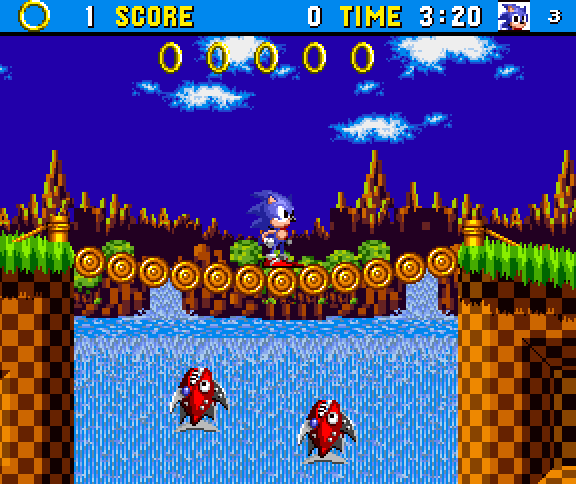
Aonic has given Amiga owners something that would have caused a few arguments in playgrounds during the early 1990s: Green Hill Zone from Sonic the Hedgehog running on a stock Amiga 1200. Reassembler’s work-in-progress demo is now available to play and uses a disassembly of Sega’s original Mega Drive game as its starting point.
The current release contains Green Hill Zone Act 1 and targets a PAL Amiga with the AGA chipset and 2MB of Chip RAM, putting an ordinary A1200 firmly at the centre of the project rather than requiring an accelerator or large memory expansion. It can also be run through compatible Amiga emulators.
Rather than recreating Sonic the Hedgehog from observation, Reassembler is adapting the game using the disassembly maintained by the Sonic Retro community. That gives the project the original game’s movement and physics as a starting point while requiring substantial changes to make the rendering work on Commodore’s completely different graphics architecture.
The 68000 is the common ground, not the whole answer
The Amiga 1200 and Mega Drive both belong to the wider Motorola 68000 family, but that does not make moving a game between them straightforward. Sega’s console builds its graphics around a tile and sprite-based Video Display Processor, while the A1200 uses Commodore’s AGA chipset and bitplane graphics.
Reassembler has therefore had to rework the rendering side for the Amiga rather than expecting the Mega Drive routines to drop neatly into place. Memory access and bus contention are among the problems involved when trying to retain the behaviour of an existing game rather than designing something around the Amiga from the beginning.
There are visible concessions in the current build. The HUD has been moved outside the main play area rather than reproducing the Mega Drive version’s presentation exactly, while the colour work draws on an earlier Amiga Sonic technology demo produced by RetroRic.
RetroRic released that separate project earlier in 2026 after experimenting with bringing Green Hill Zone to the Amiga through the Scorpion Engine. Reassembler’s project takes a different route, working from the Mega Drive disassembly and rewriting what is necessary for the A1200.
The demo also contains a level editor and the familiar level-select code from the Mega Drive game, although there are no additional stages to select yet. The editor itself remains an early development tool and is not currently optimised for running efficiently on Amiga hardware.
The biggest omission is sound. Apart from the opening Sega jingle, the current build has no music or effects. Reassembler has chosen not to bolt on a temporary solution, with audio planned for later once it can receive the same attention as the rest of the conversion.
There is no claim that this is a finished Amiga version of the complete 1991 game. Aonic remains in development, and Green Hill Zone is currently the playable demonstration of how far Reassembler has taken the idea.
Aonic shows how useful a reconstructed disassembly can be when developers want to move an old game onto hardware it was never built for. The shared Motorola heritage gives the Mega Drive and Amiga some common programming ground, but getting Sonic from one machine to the other still means dealing with everything that made the two systems different in the first place.
Aonic: The Green Hill Zone Demo is available from Reassembler on itch.io.