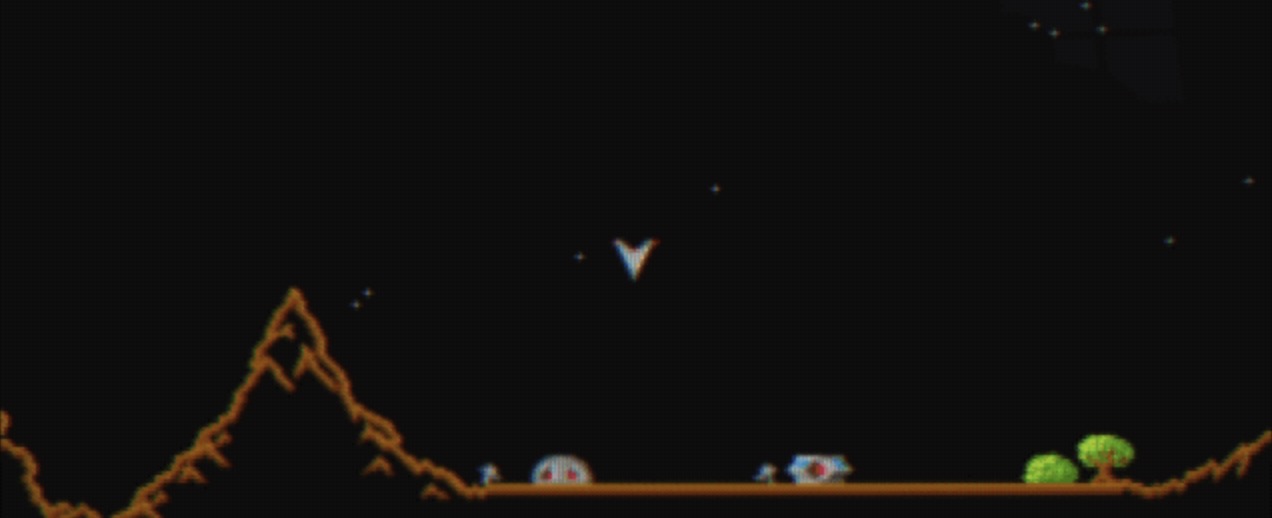
MauS has added a full planet editor to Oids on the ZX Spectrum Next. Version 1.2.0 arrived on 19th November 2026. A 1.2.1 replacement followed the same evening after the developer found a build which broke on the KS3 core.
The editor runs on the Next itself. It includes terrain and object editing, brushes, region copying and mirroring, undo, per-planet settings and a rule checker. Players also have access to playtesting from the editor, including original, modified and newly created planets.
Custom galaxies now appear in the galaxy menu with separate best scores and completion marks. The update also changes saving to write a temporary file before replacing the existing one. MauS says this prevents a repeat save from damaging a galaxy.
The new release revises docking and shield collisions alongside its creation tools. On planets with more sprite artwork than the hardware holds, some buildings now draw onto the background instead of disappearing. Scores also record after a game ends or a galaxy finishes.
The editor was part of Oids from the start
Dan Hewitt created Oids for the Atari ST, with FTL publishing it in 1987. Its rescue flights combine gravity and momentum with hostile terrain and defences. MauS’s adaptation draws on this ST version and includes its six original galaxies.
The original Atari ST package included a construction set. Players shared their creations through online services including DELPHI. FTL offered a $100 monthly prize for submitted galaxies, with the competition running until March 1989.
The Next version has developed alongside MauS’s modern computer adaptation. An August update paired Next build 0.9.10 with computer version 1.0.1.
Hardware-related fixes form another part of 1.2.0. MauS reports correcting a loading-picture hang on a 1 MB Next and adding an error message for machines without enough memory. Menu effects, the warp scene and the game-over card also receive timing corrections for 60 Hz operation.
MauS says the game detects core 3.03’s extended DMA hardware for copying and filling memory, then uses it for terrain drawing. Core 3.02 remains supported. The reported improvement comes from emulator measurements. Real-hardware confirmation remains outstanding.
The current Next download is the 397 kB Oids 1.2.1 package. SpriteFountain’s Space Pizza interview also explores a new Next game whose creator names Oids among his starting points.